Contact-form outreach into Japan · Run by a Japanese company, from Japan
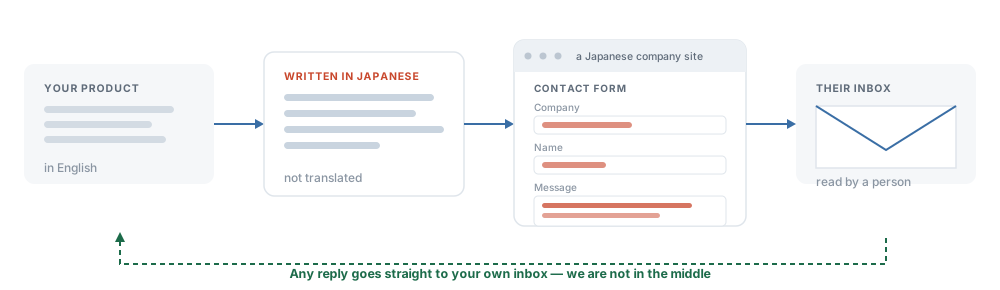
Your outreach is written in Japanese, not translated from your English, and we deliver it through the contact forms on Japanese corporate websites. You get back every company we contacted, by name, in an English report.
No Japanese entity required.
The problem
Not because Japanese companies don't buy from foreign vendors. Because the channel most teams reach for first doesn't work there, and the one that does is hard to operate from outside the country.
Japan's Act on Regulation of Transmission of Specified Electronic Mail requires prior consent, with a narrow exception for organisations that publish their own email address. In our own survey of 892,468 Japanese companies, only 32.1% published an email address at all. For the rest, there is no address to write to and no exception to rely on.
Our database, surveyed set of 892,468 companies, as of 7 Oct 2026.
Japan's corporate registry, industry portals and company databases are Japanese-only. A scraped file is a snapshot: companies close, sites move, forms get replaced. Buying a list once and mailing it for a year is the most common way this channel fails.
A Japanese manager can tell from the first line. The level of formality, how you handle the company's name, how you ask for a meeting, what you leave out — these are conventions, not vocabulary. Translating an email that works in English produces something that is grammatically fine and commercially dead.
If nobody on your side reads Japanese, the channel stops at the first reply. Most teams discover this after the sends have already gone out.
The channel
Japanese companies put a contact form on their website and treat it as the entrance for everyone they don't already know — suppliers, partners and vendors alike. Domestic sales teams use it heavily enough that it has its own name: form eigyo (フォーム営業), literally "form sales."
It is not a workaround for email being hard. It is where an unknown company is expected to knock. That is also why it is unforgiving: the form is a company's front door, and approaching it badly is visible to exactly the person you wanted to impress.
\nof the 892,468 companies in our surveyed set have a working contact form (62.2%). The share drifts down as we survey further out — the companies we reach later are the harder ones to find a channel for.
Our database, 892,468 companies, 7 Oct 2026.
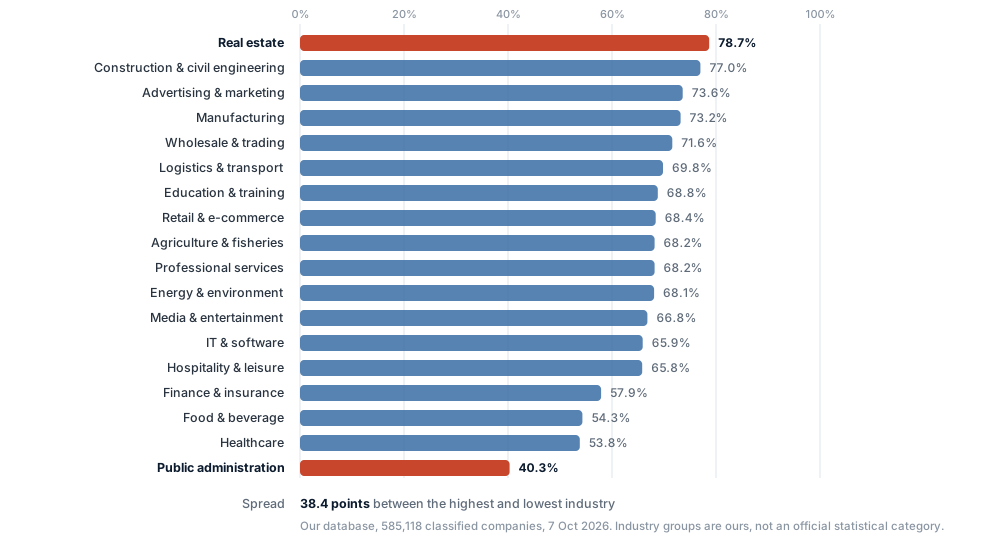
is how far form coverage spreads across 18 industries — and 34–84% once you split them into 60 sub-industries. Which segment you target decides how many companies you can reach. Budget doesn't.
Our database, 7 Oct 2026. 18 industry groups across 585,118 classified companies (40.3–78.7%); 60 sub-industries with 3,000+ companies each (34.3–84.0%).
of the companies we have approached had a bot check on their form (30.6%) — 20.8% an invisible one, 7.8% an interactive image CAPTCHA a person has to read and complete. Doing this by hand is the workload nobody estimates correctly.
Our database, 407,852 companies approached, 12 Sep 2026. Counted per company, not per submission.
How it works
Three things are needed from you, and that is the whole list: who buys from you, a Japanese page for the link in your message to land on, and your approval of the copy before it goes out.
We filter on six axes: who your prospect sells to, industry, headcount, year founded, location (down to city ward), and which source the company came from. The first axis is the one most lists don't have — it selects companies by their customers, so a product built for restaurant operators goes to companies that supply restaurants, not to everything filed under "food."
Before you commit, we tell you how many companies your conditions actually return.
A Japanese copywriter reads your product and writes the message. It is not a translation of your English sequence. You see it, in Japanese with an English gloss, and approve it before anything is sent.
We remove forms carrying a "no solicitation" notice; any company you name as a customer, partner or competitor; and any company we have contacted in the past month. We also de-duplicate shared form URLs — 27,987 companies in our database share a contact form with another company, and even after removing duplicates by company name, 16,948 of them would still receive your message twice.
Our database, 23 Aug 2026. This is the single most common way an inexperienced sender gets a complaint.
A member of our team sets up each campaign; the system performs the submissions. This is not an unattended tool. Sends run during Japanese business hours only, and every message carries a link the recipient can use to stop future contact.
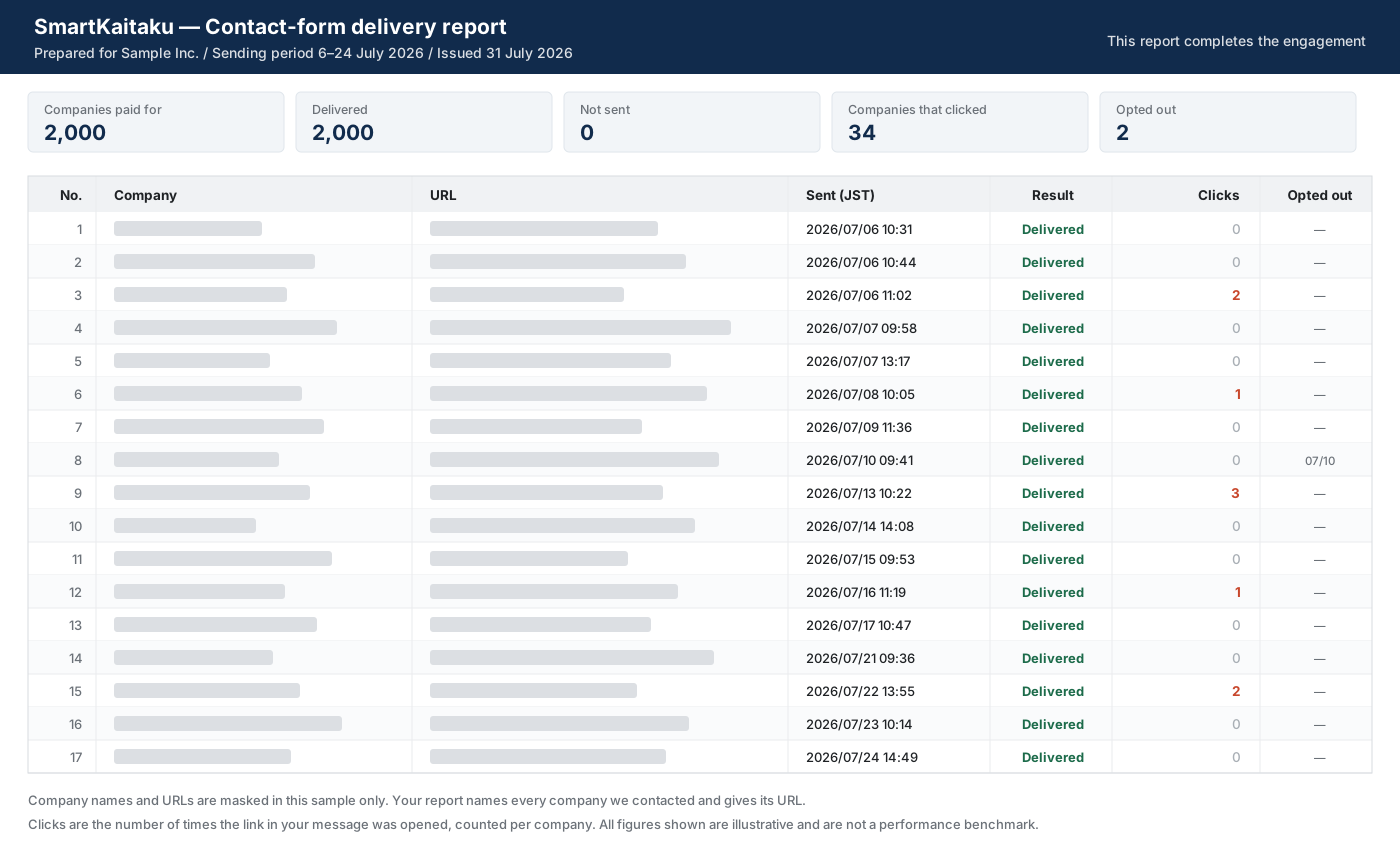
Every company we contacted, by name, with its website, the timestamp, and whether anyone there clicked the link in your message. Replies go straight to your own inbox — we do not sit between you and your prospect, so nothing waits on us.
Our data
Not a file we bought. Our own database, rebuilt continuously — and the reason a freelancer quoting you an hourly rate cannot do this job.
Our database, 7 Oct 2026. The surveyed set grows every month, so this figure moves; the registry total does not.
Of the Japanese companies in the national registry whose websites we attempted, we could reach an official site for roughly 1 in 9. We found a working contact form for roughly 7 in 100. The biggest loss is at the website stage: about 89% of registered companies have no reachable site at all.
So when someone quotes you "millions of Japanese companies," they are quoting the registry, not a reachable list.
There is a second thing the registry won't tell you: what is left when there is no form differs completely by industry. In healthcare, 53.8% have a form and 31.1% have a phone number — the gap is reachable by telephone. In IT and software, 65.9% have a form but only 7.3% have a phone, and 12.1% have no contact channel we could find at all. There, the companies you miss do not come back by another route.
Funnel ratios from our 23 Aug 2026 snapshot of 5,607,906 attempted companies. Industry figures: 585,118 classified companies, 7 Oct 2026.
Why this matters for your campaign, not just for trivia. Form coverage moves with industry (40.3–78.7%) and with whether a company sells to businesses (72.0%) or only to consumers (58.4%). It barely moves at all with headcount, founding year or prefecture. So narrowing by region or company size mostly shrinks your reachable universe without improving it — which is the opposite of the advice you will get from most list vendors.
Our database, 7 Oct 2026. Industry figures from 585,118 classified companies; target-customer figures from 584,594. Target-customer classification is ours, not an official category.
Compliance & conduct
This is the first question every serious buyer asks, so here is the full answer rather than a reassurance.
Japan's anti-spam act is defined by transmission method, and no published government material says whether a web-form submission falls inside that definition. We operate as though the act's duties apply to us rather than treating the silence as an exemption. Two of those duties bind us daily: a recipient's refusal stops us, and a published address does not count as published if it sits next to a request not to be sent advertising.
Japan's anti-spam act is defined by transmission method, not by recipient. The Act on Regulation of Transmission of Specified Electronic Mail defines "electronic mail" by reference to a Ministry of Internal Affairs and Communications ordinance, and that ordinance names two methods: SMTP, and messaging to a mobile handset by phone number. We could not find published government material stating whether a web-form submission falls inside that definition — in either direction. We therefore operate as though the act's duties apply to us, rather than treating the silence as an exemption.
The two duties that actually bind day to day. First, once a recipient tells you to stop, you stop — Article 3(3). Second, a published email address does not count as published if it appears next to a request not to be sent advertising (Enforcement Regulation Article 3, proviso). Our one-month suppression, our opt-out link and our "no solicitation" detection are how those two duties are implemented, not optional extras.
B2B advertising to businesses is a recognised practice, within limits. The MIC and Consumer Affairs Agency guidelines of August 2011 observe that sending business-product advertising to companies that publish their addresses "is actually carried out in practice" and is "considered to be accepted within a certain range as a business custom." Within a certain range — which is why the mechanisms above exist.
Consumer-protection rules are not the regime you are in. The email advertising rules under the Act on Specified Commercial Transactions exclude contracts "concluded for or as a business" (Article 26(1)(i)). A strictly B2B programme falls outside them. We do not run consumer campaigns.
Personal data. We hold corporate records and general or departmental addresses. Addresses containing an individual's name are excluded from our lists.
CAPTCHAs. Where a form presents an image CAPTCHA, a person on our team reads and completes it. We do not defeat access-control functions within the meaning of the Act on Prohibition of Unauthorized Computer Access, Article 2(3).
And one layer that is not law at all. Many Japanese forms carry their own terms of use, some of which refuse sales contact or state a charge for it. We treat a stated refusal as binding whether or not a statute compels it. That is a commercial judgement, and it is also why our target counts are lower than a scraper's.
This describes how we operate. It is not legal advice and it is not a compliance opinion about your product or your claims. Your outreach copy remains subject to Japanese advertising and labelling rules, which bite hardest on regulated categories — medical, financial, food and health claims among them. Have your message reviewed by your own counsel before launch, and tell us if your category is regulated so we can plan around the review.
What you receive
Seven days after the last send. The report is the deliverable — the engagement is not complete without it.
Company name, website, and the timestamp of the submission — one row per company. You can audit the entire campaign, and you can check that we stayed inside your exclusions.
You get the number of companies you paid for. If a form turns out to be unusable, it is replaced, not deducted.
The report shows what comes back. This shows what goes out. Below is a message of the kind we write — here for an invented client, a company selling equipment-monitoring software to Japanese manufacturers.
The middle paragraph is written for each company individually, after someone has read that company's own website. It is not a template with the company name dropped in, and it is not your English email put through a translator. That paragraph is the entire reason this channel works at all.
The middle three sentences follow a house style built from 6,147 messages that passed internal review: four sentences or fewer, the reader's actions in honorific form and ours in humble form, and never two humble constructions in a row. You approve your own version before anything is sent.
What to expect
of companies contacted turned into a confirmed meeting, across our own 2026 campaigns. A meeting counts once the date is agreed with the prospect — not when a reply arrives. That distinction matters: a "response rate" from another vendor is usually several times higher and means much less.
At 8,000 companies a month, that range is 8–16 meetings. It varies with industry, product and copy, and we do not guarantee it.
Month one is a reading, not a result. The first report tells you which industries engaged and which message got clicked. The second campaign is built from that. Judging the channel on a single send is the most common mistake.
A positive reply in Japan is rarely a decision. It is permission to enter an internal consensus process involving people you haven't met. Expect a longer cycle than in your home market, and don't push.
We hand you pipeline, not closed deals. We do not run your meetings and we do not negotiate on your behalf. If you need someone to carry the deal, you need a sales partner in Japan, and we are not that.
Pricing
Prices in USD. No Japanese consumption tax is added — the service is supplied to a business established outside Japan, which puts it outside the scope. What you see is what you pay us.
Start here
One campaign, run by email, no commitment. Buy the answer to "does our message land in Japan?" — before committing a budget to finding out.
$1,000 once
One-off — nothing recurring
We agree the targeting first, then send you a Stripe payment link. Roughly 3 weeks from payment to report.
Most chosen
A fixed monthly spend you can put in a budget line. Predictable, capped, no variable fee.
$2,400 / month
No per-meeting fee
Billed monthly by card through Stripe. Total spend is fixed.
Risk shared
Twice the volume for $200 more, and we take our upside from meetings instead of the retainer.
$2,600 / month
+ $200 per confirmed meeting
Billed monthly through Stripe; meeting fees are added to the next month's invoice. See the definition below.
What a 2,000-company pilot can and cannot tell you. At our own 2026 meeting-set rate, 2,000 companies works out to two to four meetings. That is too few to be a result. A pilot that returns no meetings has not shown the channel doesn't work for you, and one that returns five has not shown that it does — at this volume either outcome is inside the noise, and we would rather say so now than explain it afterwards.
What 2,000 companies does measure reliably is the part you cannot find out any other way: how many Japanese companies clicked the link in your message, which segments they came from, and what the replies actually say. Clicks run far ahead of meetings, so the signal is there at this size. That is what tells you whether to scale the same message, rewrite it, or change the segment — which is the decision the Pilot exists to inform. If you want a meeting count you can rely on, start at Standard.
Only the first of these has a price per plan. The rest are quoted or charged once, so they are listed as they actually work rather than forced into three columns.
Every Japanese reply translated into English and sorted into interested / not now / decline, with a suggested reply drafted in Japanese for you to approve. Turnaround one business day.
A single Japanese page for the link in your message to land on — written in Japanese, not translated, with one round of revisions. Delivered as a self-contained file you host on your own domain, which is better for your own search presence than a page on ours. Sending Japanese outreach to an English page is the most reliable way to waste the campaign.
Includes forms that present an interactive image CAPTCHA, which a person on our team reads and completes. Roughly one company in thirteen uses one. It widens your reachable universe and lowers the company count at a fixed price.
We can send to a list you supply, provided each row carries the company's contact form URL. Rows without one have to be researched first.
Per-message pricing tells you nothing useful. What you are deciding is how to get in front of Japanese companies at all. The honest comparison is against a bilingual sales hire in Tokyo, where base salary alone runs around USD 48,000 and the first meeting is months away.
| Plan | Monthly cost | Companies / mo | Meetings at 0.1% | at 0.2% | Cost per meeting |
|---|---|---|---|---|---|
| Standard | $2,400 | 8,000 | 8 | 16 | $150–300 |
| Performance | $2,600 + fees | 16,000 | 16 | 32 | $281–363 |
| One bilingual SDR in Tokyo | ~$4,000+ | — | — | — | Hiring cycle first |
Calculation: companies contacted × meeting-set rate = expected meetings; cost ÷ expected meetings = cost per meeting. The 0.1–0.2% range is our own 2026 result and is not a forecast for your product. The SDR figure is an indicative base salary for Tokyo and excludes employer costs, tooling and management time. Pilot is not in this table — see the note above the add-ons for why.
Standard costs less per meeting if the channel works. Performance costs less if it doesn't. That is the trade: twice the coverage for $200 more, with our upside coming from outcomes rather than the retainer.
What counts as a confirmed meeting ($200). A call or meeting with a target company where the date and the attendee are agreed, and the prospect has confirmed in writing in the reply thread. Billed monthly in arrears. A cancellation or no-show is not billable if you tell us within five business days. We never invoice a meeting fee in advance, and we never count a reply as a meeting.
How you pay. Nothing is charged on this page. We agree your targeting through the form first. Once the scope is settled, a Pilot is paid through a Stripe payment link, and a monthly plan is set up as a Stripe subscription charged to your card each cycle. On the Performance plan the meeting fees are added to the following month's invoice, never taken in advance. You can cancel a subscription at the end of the minimum term by telling us before the final month.
Tax. No Japanese consumption tax is added. The service is supplied to a business established outside Japan, so it falls outside the scope of the tax. Depending on where your company is, you may still need to account for VAT or GST yourself under your own country's reverse-charge rules — that part is between you and your own accountant.
Fit
We would rather lose the sale here than three months in.
FAQ
There is no single statute that settles it, which is why you will see confident answers in both directions. We set out the full position, with the citations your counsel will want, in compliance & conduct above.
A fair question, and the answer is in the volume per recipient, not in the technology. Of the messages we have delivered, 99.55% of companies received exactly one, and none received more than two. We suppress for a month, we remove forms that say they don't want sales contact, we de-duplicate shared form URLs, and every message carries a way to stop. A sender who skips those four things is running something materially different from what we run.
Our database, delivered submissions, 25 Aug 2026.
No. We contract with your entity wherever it is. What you do need is a Japanese page for your product for the link to land on, and a plan for who takes the meeting.
Replies go directly to the inbox you nominate, so nothing waits on us. If nobody on your side reads Japanese, add Reply Desk: we translate every reply, sort it into interested / not now / decline, and draft a Japanese response for you to approve, within one business day. It is an add-on rather than standard because most clients with a Japanese-speaking colleague prefer to answer in their own voice.
A Japanese copywriter on our team writes it after reading your product. You see it with an English gloss and approve it before anything is sent, and you can supply your own Japanese copy instead if you have it.
You give us the names or domains and we exclude them before the first send. You can add to the list at any time, and because the report names every company we contacted, you can verify it rather than trust it.
Anywhere from a few thousand to a hundred thousand, depending which one. Across our 18 industry groups, coverage runs from 40.3% in public administration to 78.7% in real estate, and the groups themselves range from 3,212 companies to 108,953. Split into sub-industries the spread is wider still — 34.3% for hospitals and clinics, 84.0% for property sales agencies. Tell us your targeting and we will tell you the real number before you commit. The check is free, and it is the right way to size a campaign.
Our database, 7 Oct 2026, 585,118 classified companies. Industry classification is ours, not an official statistical category.
Pilot has none — it is a single campaign and it ends. Monthly plans run for a minimum of three months and then continue month to month; tell us before the final month of a cycle and it stops. Three months is not a lock-in device: at a 0.1–0.2% meeting-set rate, one month cannot tell you whether the result came from the copy, the targeting, or chance. If you are not ready to commit three cycles, run the $1,000 Pilot instead and decide afterwards.
No, and we would not believe a vendor in this category who did. What we commit to is the volume you paid for, the exclusions you specified, the copy you approved, and a report naming every company we contacted. The Performance plan is how we put our own money behind the outcome without pretending it is certain.
We work Japan time (JST, UTC+9), so our working day overlaps the morning in Europe and the previous evening on the US west coast. We answer enquiries in English within two business days.
Once a campaign is running you also have email support around the clock, so a complaint or a problem mid-send always has somewhere to go.
Not yet, and we would rather tell you that than manufacture one. We run this channel for Japanese clients, but outside Japan you would be among our first, and we have no English-language references to offer you.
So here is what we put in front of you instead. The sample report above, so you know exactly what lands in your inbox. The Japanese message we would write for you, which you approve before anything is sent. And a free count of how many Japanese companies actually match your targeting, run on your real criteria before you pay anything.
Those three tell you more about whether this will work for you than a reference call with a company in a different market and a different language would. When we do have clients outside Japan who are willing to speak, this answer will say so.
Get started
We will come back with how many Japanese companies match, what we would say to them, and which plan fits. No charge for the count, and no obligation.